whitetails myths

20+ Whitetail Myths Debunked

do you have to wear orange when hunting

Myth:  Deer can’t see colors.  Here are the facts:

Can white-tailed deer see colors?  Hunter orange, or blaze orange, is a common color often associated with the myth of deer not being able to see colors.  However, just because deer do not respond to hunter orange the same way humans do, doesn’t mean that they can’t see them.  Florescent orange glows to humans, yet deer seem to have a hard time picking it out in the whitetail woods.

I have a British Lab and I’ve noticed a drastic difference in her ability to see the color red when playing fetch.  I purchased a small red toy for her and if I throw it in the leaves or an area that it doesn’t stand out against a different color background, she has trouble finding it until she catches it’s scent.  She’s got a great nose on her, but the color red doesn’t stand out against similar colors.  We’ve since retired this toy and now use a different color and she’s able to see it without issue.  This observation allows me to better understand how deer perceive colors as well.

Research dating back to the 1980’s proves that deer can in fact see some colors.  More recent research by the University of Washington and the University of Georgia began to reveal some very specific facts about what deer see. By dissecting a whitetail’s eyeball and putting it under a high-powered microscope, scientists were able to analyze the color vision in whitetails by looking at the rods and cones on the retina.

Rods collect light and cones interpret colors. By analyzing the specific kinds of cones in the deer’s eye, scientists discovered that deer do not see the red end of the spectrum visible to humans, but they see the blue end significantly better than we do. Colors like orange and red are subdued, but greens and blues are very visible to deer.

Humans have a UV filter on our eyes, which blocks out much of the blue light that can harm our eyesight over a lifetime. Because deer live much shorter lives, they do not need this filter. Between the lack of a UV filter and the number of cones that interpret blue light, a whitetail deer can see blue approximately 20 times better than humans can.

Colors to avoid wearing while hunting:  BLUE and YELLOW

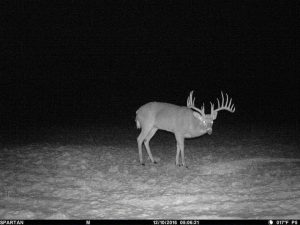
awesome big buck trail camera photo

Myth:  Bucks only travel into the wind

Have you ever heard people say that bucks only travel into the wind?  This means that a buck will only walk in the direction that the wind is coming from, ensuring they can smell what’s in front of them.

The likelihood of a deer being able to travel into the wind 100% of the time would be astronomical.  This myth comes from hunters that have been busted by a downwind buck due to poor scent control practices or bad treestand placement.  If bucks only traveled into the wind, deer would be nomadic and never have a routine, but one walk through your favorite hunting locations can bust this myth.  Have you ever seen a rub line, scrape line, or deer trail?  That kind of sign wouldn’t be available if bucks only walked into the wind.

Now, a smart animal will use the wind in their favor, to scan the area before making an appearance into dangerous areas such as food plots or bait stations.  Many animals, including big bucks, will circle downwind to check and see if it’s safe to enter before stepping out of the concealment of cover and into a vulnerable field.  You can use this to your advantage and anticipate a buck’s behavior in certain circumstances but don’t expect deer to be walking into the wind all of time.  Also, don’t forget about bedding areas, as most deer will bed with the wind at their back and their eyes looking in the direction that wind is blowing.  This allows them to smell approaching danger, and watch their downwind side for predators.

best way to find bucks

Myth:  Deer don’t move on windy days.

The wind can play a major factor in a hunter’s level of comfort while hunting.  A strong wind decreases the body temperature quicker, making it much harder to stay warm.  Factor in a swaying tree, and most hunters would prefer to stay home.  The myth that deer don’t move during the wind was debunked by Penn State University after a three-year study utilizing radio telemetry and weather data. The research showed that deer will actually move more in high winds, either to stay cold or to ensure their safety from predators because their sense of smell and hearing is reduced.

Now, deer will change their movement patterns on high wind days and choose areas that are protected by the wind.  Deer will find windbreaks, such as fallen trees, rocks, cliffs, creek bottoms, and the backside of the hill where the wind speed in reduced.  Pay attention to OnX Hunt and watch your wind direction and look for areas where deer are likely to try and get out of the wind.

deer only hit scrapes at night

Myth:  Bucks only visit scrapes at night

Scientific studies can be misleading, especially when it comes to rutting activity.  The unpredictability of the rut creates a wide variety of oddities in the whitetail woods.  Scientific studies proves that the majority of activity on scrapes are done at night, with some studies stating that as much as 80% of the activity is done at night.  However, the majority of deer movement is done at night, so why would this be any different?

The biggest factor is whether deer are going to visit a scrape during the daylight is the location of the scrape. During the pre-rut, a large community scrape close to bedding can be dynamite, while field edge scrapes might go untouched during daylight hours.  This one is easy to test for yourself, all you need are a few well-hidden trail cameras watching over scrapes in your area and you’ll quickly find out that bucks will eventually check an active scrape during the daylight.  However, not all scrapes are going to be checked each day, or during daylight.

Myth:  Twins deer fawns are genetically identical

Did you know that most whitetail fawns are not identical twins?  Unlike humans, twin fawns can have different fathers!  Identical twins are quite rare. Generally, the doe produces two separate eggs, rather than one alone that splits. Also, it’s not uncommon for a doe to have multiple partners!

do big buck produce the best fawns

Myth:  You have to be in your treestand before daylight

Is it better to approach your stand in the dark of the morning or wait until it’s light enough to see?  This one is hard to debunk because there’s always more than one way to skin a cat (or kill a deer).  I learned this lesson at an early age during West Virginia’s rifle season.  I woke up early, climbing to the ridge-top an well before first light, waiting for the magic to ensue that opening day can bring.  My uncle stayed behind, choosing to slip into his stand just after daylight.

The crack of his rifle in the distance proved his theory that he’d rather slip through the woods cautiously during the daylight, taking the chance of not spooking deer in the distance, instead of walking aimlessly through the dark hoping that deer wasn’t nearby.  Years of hunting with a rifle taught him that he’s more successful if he waits until daylight to walk to his stand.

For bowhunters, getting within bow range on the ground can be much more difficult, but the benefits are still the same.  Deer can see better at night and low-light than humans, so just because you can’t see them in the darkness, doesn’t mean they can’t see you.

Walking in and out of your hunting location when it’s light enough to see allows you to be quieter and hopefully you’ll spook less deer!

biggest typical whitetail bucks ever

Myth:  Big antler bucks produce only big antler buck fawns

The better genetics, the bigger the buck, some of the time.  Genes for big antlers from the father is only a small part of the equation. The big buck genetics are often passed through the doe as bucks pass their antler genetics to their buck and doe offspring.

Science has stated that the majority of the antler genetics come from the doe and it’s not a 50/50 split.  The stars have to align for a buck fawn to reach its full potential and it starts with having good genetics from both the mother and father.  However, it’s the mother that has to provide nutrition to the fawn during pregnancy and while nursing.  To sum it up, the best mothers, make the healthiest bucks, including big antlers.

I have a friend who raises deer and I have learned a lot about antler genetics from him. He tells me that he can predict when a buck will blow up into a giant based on the genetics of the buck fawn’s mother. When he breeds a doe with big antler genes to a buck carrying big antler genes, that’s when the buck fawn is likely to become a giant because he has the genetics to do so from both sides.

Also keep in mind that big antlers are the result of age and nutrition. The buck’s mother is responsible for keeping the fawn fed and teaching it to search out quality food and minerals. She is also responsible to teach that buck fawn the survival strategies that will allow him to reach 5-6 years old when his rack can fully develop. So both in the genetics and in the behavior that creates a big antlered buck, a doe has much more responsibility than just the genetics of the  buck’s father.

Can I kill a mature buck in October

Myth: There’s no point in hunting during the October Lull 

Fake news!  This timeframe between early season patterns and pre-rut activity drastically impact deer movement and feeding routines.  However, it’s not that the deer aren’t moving and go into hiding for a week or two, they simply change their routine.  For my area, acorns start to fall and soybeans are turning yellow, so deer are less visible in fields and stay in the timber much more.

I killed one of my best bucks during the October Lull by capitalizing on a deer that changed patterns, including a new bedding location and feeding area.  Learn more about how I beat the October Lull.  Factor in the first cold front of October and you could be in for a real treat in the whitetail woods.

do big rubs mean big bucks

Myth: Big Rub Means a Big Buck

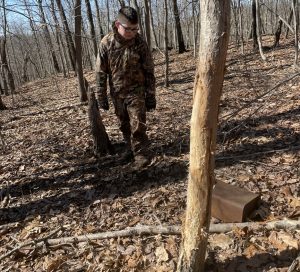
One of the most exciting pieces of deer sign in the whitetail woods is big buck rubs.  There’s no single piece of fresh sign that makes hunters think that there’s a big buck in the area than a big buck rub.  However, if you run enough trail cameras, you’ll quickly learn that not all big bucks make big rubs, and not all big rubs are made by big bucks.

I’ve got a property that I hunt in West Virginia that is littered with big buck rubs, but big bucks are few and far between.  When I say big rubs, I’m talking trees up to the size of a basketball in diameter.  These big buck rubs are a staple of the area and appear to be a calling sign of the local deer herd, regardless of the antler size.  The basketball-sized rub, was made by a 130″ 8 point that I passed up multiple times that season because he wasn’t the biggest antlered deer on the property, but this giant rub showcased his dominance in the area.

Now, if you take a walk through my Ohio property, you’ll be lucky to find a rub on a tree larger than a baseball. However, the bucks are much bigger!  The only way to prove if a big buck is making a big rub is to set a trail camera nearby and hope for a photo of the buck.

how good can deer heear

Myth: Deer Hear Better Than Humans

Surprising to most, deer can’t hear much better than most humans do. While deer are more attuned to higher-pitched sounds, humans are believed to be slightly better at perceiving lower tones. That said, deer are much better than humans at pinpointing the source (direction) of a sound, and if it’s unnatural to the environment (safe or unsafe).  This is a fancy way of saying that deer are able to distinguish natural sounds from unnatural sounds, including the cadence of your walk through crunchy leaves in the fall.

If you spend enough time in the woods, you can distinguish the sounds of a deer walking through the woods vs a scampering squirrel.  If we can do this with our limited time in the outdoors, imagine how easy it was for a deer to distinguish the differences.

huge deer herd early season

Myth: Buck-to-Doe Ratios are skewed in my area

Guilty as charged.  I had a saying growing up that for every 10 deer I saw, one would be a buck. This might have been true on certain hunts, but it doesn’t mean that the buck-to-doe ratio was 9 to 1.  The truth is, I just wasn’t hunting where the bucks were and I counted every deer that didn’t have antlers as a doe when half of all fawns are buck fawns.

It is biologically impossible to have a pre-harvest ratio that’s so skewed. Because 50% of fawns recruited into the herd each year are bucks, you get an automatic correction each spring and summer. Because of this, it’s biologically impossible to have a reasonable, pre-harvest ratio more skewed than 1:4 or 1:5, and 1:2 or 1:3 are much more likely.

Hunters and hunting regulations can impact the sex ratio within the deer herd, but mother nature will eventually correct our mistakes.

big wv buck

Myth: Dominant Bucks Breed the All the Does

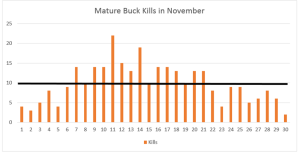
Dominant whitetail bucks do not keep harems like elk, where the bull in charge breeds the cows.  Studies show that the majority of does are bred by 2.5 and 3.5-year-old bucks, as they’re often the most active in the breeding process.  These young bucks are chasing every doe they can find and are more frantic in their approach.  Plus, there are a lot more 2.5-year-old bucks ou there than 5.5-year-old bucks or older.  Therefore the largest population group is going to breed the largest population of does.  The majority of the breeding process is established during the first couple of weeks of November in most areas of the country, and there’s only so much breeding one buck can do during this time.

Mature bucks seek out receptive does and will repeatedly breed the same doe during their estrous period. Then they will move on to other does. It is also not uncommon for various older and younger bucks to breed the same doe, leading to multiple paternity.

will deer cross a river

Myth: Hunting Pressure Will Get Deer Moving

Rifle season in West Virginia would drastically increase the hunting pressure throughout the state and I often heard that human pressure would get the deer moving.  This became evident once I learned about deer drives in Ohio, where guys would push deer out of thickets and timber to try and shoot one running out the other side.

This deer movement isn’t quality deer movement.  Hunting pressure pushes deer from areas where people are, to areas where they feel safe.  Once they find safety, they’re not coming out until the hunting pressure is reduced.

whitetail fawn

Myth: Fawns Have No Odor

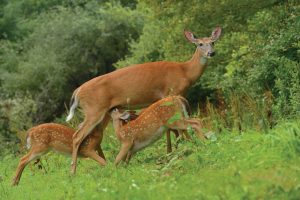
Fawns are limited in their self-defense to predators and many people think that deer fawns do not have an odor.  Fawns do have less scent than adult deer. That’s why does spend most of their time away from their offspring, reducing the likelihood that they’ll contaminate the area with their scent.  However, fawns aren’t completely scent-free. They have a slight smell, they still poop, pee, and even sweat, so of course they’re going to have a scent.

what is the best day of whitetail rut

Myth: Moon Phase Impacts Deer Movement

Deer hunters, especially those that produce moon guides and other products related to reducing deer movement continue to live and die by the moon phase.  However, research shows that the moon phase has absolutely zero to do with deer movement.  PSU Wildlife Biologist Jeannine Fleegle echoes this statement by saying, “We’ve said it before, and we’ll say it again – the full moon has no effect on deer movements.”

Even Dr. Grant Woods of Growing Deer TV, whose earlier research in the 1990s pointed to 72% accurate predictability of deer activity, has stated he sees no link between lunar cycles and deer and elk movement.

Forget the moon and just hunt!

whitetailed deer fawn photo

Myth: Lone Fawns Have Been Abandoned

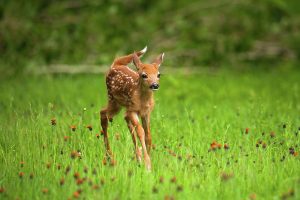
Uneducated people commonly post photos of lone fawns saying they’ve been abandoned. Unless you know the doe is dead, the fawn has not been abandoned. It is common behavior for whitetail does to spend minimal time with their fawns to reduce the odds of fawns being predated.

Ohio whitetail deer

Myth: Mature bucks are homebodies and their home range gets smaller with age

As long as deer have everything they need, they’ll stick around – WRONG!  Buck fawns are often kicked out of the area in which they’re born and raised, but their mothers to help prevent inbreeding.  This natural occurrence happens all over the country.

Also, once a buck finds a new home range, it’s not uncommon for them to venture out on what’s been called an excursion where the buck takes a long road trip and eventually return to the area each year.  GPS collar studies back up this with data where deer are often gone from their adopted home range for a couple of weeks throughout the year.  These are often done to find doe bedding areas as the rut approaches.

Now, just because a buck calls an area home today doesn’t mean he will still be there tomorrow.  Human pressure and environmental conditions drastically impact whether a deer feels safe in the area.  Predators, people, cover, and food always impact their choice to stay or not!

pretty deer sunset pic

Myth:  Big bucks only move at dawn and dusk.

Whitetail deer are crepuscular animals, so yes, bucks move most often at dawn and dusk.  But it’s not a guarantee that bucks aren’t moving during other times of the day.  Each season, I get random trail camera photos throughout the season and I ask myself why is that buck moving right now?  Maybe he’s checking a scrape, drinking water, or changing bedding locations.

Many hunters have learned to hunt mid-day during the rut, as bucks will wait until does return to bedding locations and then scent0-check these locations mid-day.  Try setting up downwind from doe bedding areas during the rut on mid-day hunts.  If you’re not hunting mid-day during the rut, you’re missing opportunities to fill tags.

Outside of the rut, I’m not hunting mid-day.

wv whitetail buck

Myth: Culling Improves Antler Genetics in Whitetail in the Wild

Cull Buck!  The worst two words in the hunter’s vocabulary.  Hunters have used the cull buck theory for decades as an excuse to kill young bucks.   Numerous studies have proven that hunters cannot impact the genetics of a wild whitetail herd. Not with culling, supplemental feeding, or minerals.  In the wild, there are too many uncontrollable factors.  Antler growth is impacted by four things, including age, environmental conditions, genetics, and nutrition. Hunters can influence only two of those — age (allowing deer to get older) and nutrition (improving the habitat).

Does are the key to big buck genetics.  They contribute half of their offspring’s antler genetic code, and there’s no way to determine if a wild doe has good genetics to pass on or not. Also, the doe takes care of a buck for the first year of its life, and if she does poorly, it can impact a buck’s antler production for the rest of its life. Furthermore, recent research shows that antler genetics aren’t as highly heritable as once believed.

The idea of killing cull bucks to produce better genetics silly.  However, too many deer on the landscape could be detrimental to the herd and hold them back. Deer have a genetic code that they could potentially release if the stars align it takes a miracle to reach it in the wild.

Myth: Mature Bucks Live in the Thick, Remote Areas

Whitetail bucks prefer seclusion, but that can look different to them than us. Deer frequent areas wherever they find their basic needs (cover, food, and water) and safety from hunting pressure. That might be in a very remote rural area, but it can also be pockets of cover in suburban areas, inside the city limits.  Have you seen some of the giant bucks being taken in big cities in recent years?

Also, this same principle applies to public land.  Everyone thinks you have to travel in further than everyone else, and there might be a big buck in there.  However, smart hunters have learned that bucks will often bed close to the access roads and watch hunters walk in and out of the property, keeping the upperhand.

will trail cameras spook deer

Myth:  A full moon is the worst time to hunt.

This myth might live on in deer lore forever, but big bucks still move on a full moon.  A full moon provides more light during the darkness of night, and it makes sense that deer will move more at night because they can see better.  Factor in snow-covered ground and the snow reflects the light of the moon and it’s like it never gets dark during a full moon.

But can you kill a big buck during a full-moon?  Absolutely, you’re crazy if you let a full-moon keep you from hunting during the right conditions.

tips for using a topo map

Myth: The bigger the property, the better the hunting

If there’s one myth on this list that couldn’t be further from the truth, it’s this one.  Not only am I an avid deer hunter, I’m also a real estate agent with Whitetail Properties.  During my day job, I walk some of the best properties in Washington County Ohio, and the surrounding area and sometimes it’s the small tracts of ground that produce the biggest bucks!

Don’t believe me?  Check out Seek 1 on YouTube and you’ll be amazed by the number of giants they’ve killed on small tracts of ground.  Human nature says the bigger the property, the more big bucks on it, but that often means more hunting pressure too, especially on public grounds.  Private ground can be the same way also, as bigger property owners are more likely to give multiple people permission than a small acreage landowner.

When you plan your next public land hunting adventure, don’t overlook the small tracts of ground that most hunters don’t consider worth hunting.

Hunting Gear Deals is funded by affiliate commissions. We may receive a small commission when you buy from our partners using the links provided. There is no additional cost to you. Thanks for supporting us by using our links when making your purchases.

Most Popular

Menu