
If you hunt in areas of the country that have black bears, you’ve probably heard the old saying that bears have poor eyesight or what they lack in vision they make up for in their sense of smell. So, do black bears have poor eyesight? The truth may surprise you. Here is some recent scientific research that has revealed some interesting things about the eyes of a bear. We will even learn whether or not a bear can see better than a human.
How does a bear’s eye work?
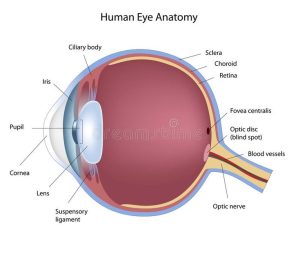
The functionality of a bear’s eye is similar to that of a human, except that they do not have a biult-in UV filter. The eye is made up of five basic parts, contained within the ciliary body:
- Cornea
- Retina
- Pupil
- Optic Nerve Head
- Lens
The cornea is the protective layer over the lens. Humans have a built-in UV filter in the eye where most animals do not. The lens is right behind the cornea and it serves to collect light and direct it onto the retina, kind of like an overhead projector that we used to use in school. The pupil opens and closes to change the amount of light that passes into the eye, like the blinds in your house. The retina is the back of the eye and the light that hits it is sent to the brain through the optic nerve.
Predator vs. Prey
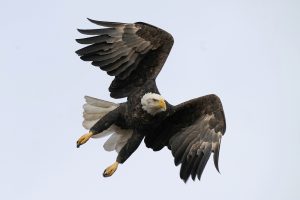
Have you ever heard the saying “eye’s like a hawk?” Well, there’s a reason for that as it’s an adaptation to being able to hunt for prey, relying on their vision over their other senses. Eagles are known for their keen eyesight but what are bears known for? Their sense of smell, but that doesn’t mean that they have poor vision, just that they rely on their nose more so than their eye sight. Which is the inverse of the eagle.
Now here is where things get interesting. The eyes of predators, such as bears, are optimized differently than those of prey species, such as deer. If you pay attention, you will notice that your eyes are moving along the lines of type as you read this. Your eyes have a very small point of focus, and everything within your field of view around that point of focus is peripheral vision, but it is out of focus. Look at something in the distance, and bounce your eyes around to look at different things around you. Your eyes move and settle on objects and then your eyes focus on that object. It’s actually a small point that is in focus. That’s because there is a small area on your retina (that screen in the back of the eye) that interprets the light coming through the lens. A bear’s eye is very similar.
The eyes of a deer work much differently. They have a wide band of area on their retina that can interpret light, allowing them to see better after dark than you and I. Also, the way they’re positioned on their head allows for a greater field of view!
The eyes of a predator, such as the bear, are positioned more towards the front of the head, while prey species have them more to the side. It takes two eyes at once (binocular vision) to correctly read depth perception. The brain calculates the difference in distances between the object and each eye, and provides an ability to see in three dimensions. Bears have what’s called binocular vision for the entire 120-degree field of view allowing them to

How well can a bear see color?
Can bears see color? Yes, science indicates that bears can see color very well. This was determined by the number and position of the rods and cones in their eyes. Rods collect light, and cones interpret color. Bears particularly see colors on the blue end of the spectrum very well. They may not see reds as well as we do, but definitely better than deer.
The human pupil is round and opens and closes quite quickly. The pupil in a bear’s eye is a slit that opens a little more slowly but it actually opens almost twice as wide as ours. This allows for the collection of more light in low-light or dark conditions. Bears, like deer, have a layer of shiny substance on the retina at the back of the eye. This is called tapetum lucidum. When you shine a light in the eyes of bear, you will see a “glow” which is actually the light reflecting off the retina and shining back at you. It is one of the reasons bears can see so well at night. I mentioned that rods collect light. Bears have about ten times as many rods as you and I have. Plus, when the light is reflected off the tapetum lucidum, it then hits the rods a second time, effectively doubling the amount of light that the bear’s eye can send to the brain for interpreting the world around them. Because of the numbers of rods, the size of the pupil opening, and the doubling of the light by reflection, a bear’s eye can collect about 50 times as much light as our eyes. Believe me, when a bear comes into your bait at last light, he can see you a whole lot better than you can see him!
So, just how good is a bear’s vision?
Humans are known for 20/20 vision, with some humans having vision as good as 20/10, and those needing glasses having much worse. Research from the University of Georgia and the University of Washington found that white-tailed deer have about 20/40 vision. Which isn’t as good as humans.
Bears are said to have the same eyesight as humans. However, not all bears will see as well as as 20/20, especially as they get older. (just like humans!)

Why do people think that bears have poor vision?
So where did this myth come from that bears have poor vision? Human interactions with bears, myself included, have proved to me that bears don’t rely on their eyesight as well as they do their nose. If a bear gets downwind of a stinky human, he’s gone. But I’ve been visually spotted in a treestand multiple times and bears seem more curious than they are afraid. BINGO – an apex predator isn’t afraid of what it can see. However, if you let a deer see you, you don’t stand a chance. Predator vs. Prey
Hunting Gear Deals is funded by affiliate commissions. We may receive a small commission when you buy from our partners using the links provided. There is no additional cost to you. Thanks for supporting us by using our links when making your purchases.