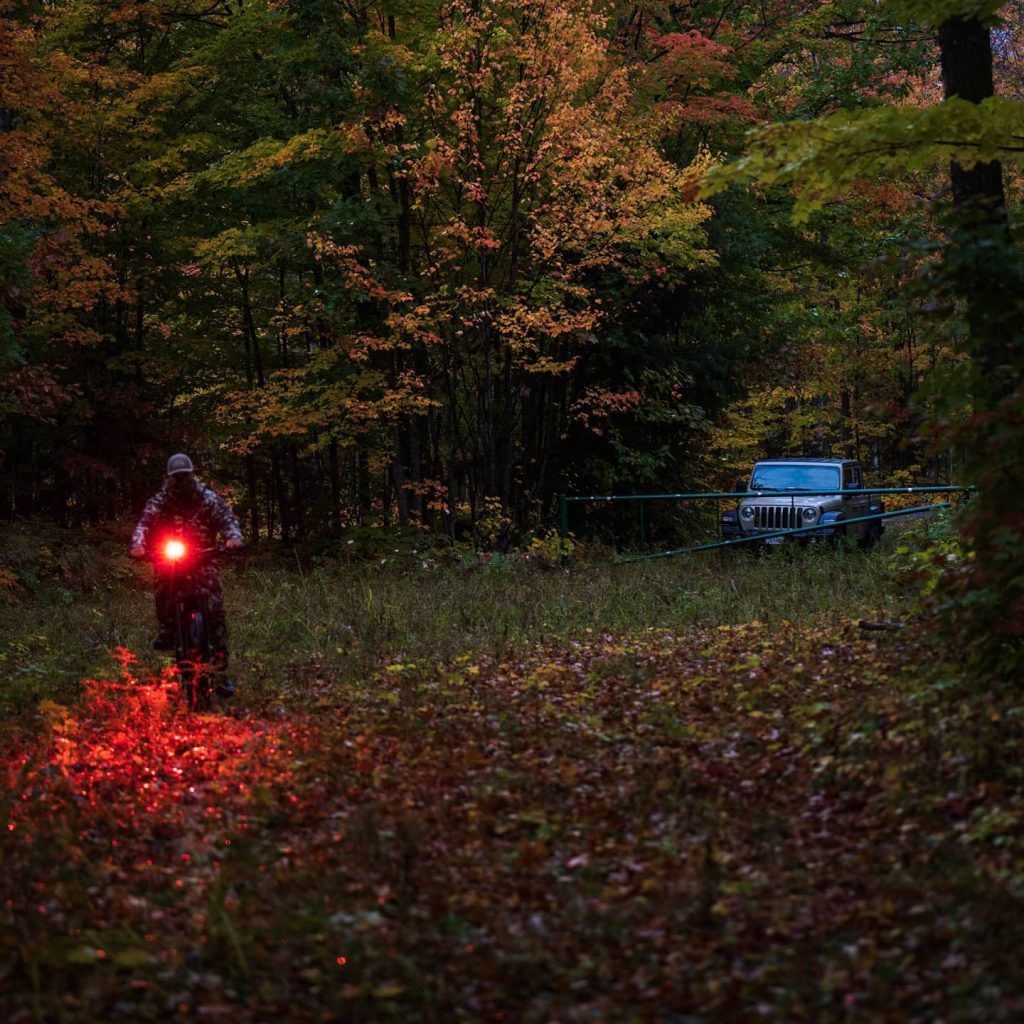
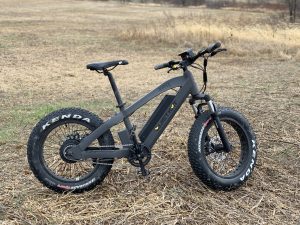
Photo Credit: QuietKat

Is an E-Bike Legal on Public Land?
Can I use a QuietKat electric bike while hunting on public land? The advancement in technology has surged the e-Bike industry, creating opportunities for hunters like you and me to benefit by incorporating e-Bikes into our hunting strategy to access hard-to-reach areas. If you’re solely hunting private ground, you’ve got nothing to worry about, go pick up a QuietKat and thank me later. However, if you plan on utilizing your e-Bike on public ground, you’re going to want to do your homework first.
Unfortunately, e-Bikes aren’t accepted everywhere, so I’m going to attempt to steer you in the right direction for the state that you’re hunting. State electric bike rules and regulations change regularly, so use this as a guide, not law. I recommend you check your local laws periodically, so you can legally enjoy the benefits of riding your electric bike. It’s a great idea to talk to the local Conservation District in the area in which you plan on using an eBike prior to showing up for your next hunt.
What is an eBike? E-Bike Definition and Classification
Electric bicycles are classified into three different classes and the regulations increase in scrutiny as the mechanical capabilities improve, which is detailed below.
Class 1: Top speed of 20 miles per hour and an electric motor that works only with pedaling (pedal assist).
Class 2: If the bike is equipped with a throttle-actuated motor. That motor must stop providing power when the eBike reaches 20 miles per hour.
Class 3: A Class 3 eBike is a bicycle with a motor that provides assistance only if the rider is pedaling and should cease to assist when the eBike reaches 28 miles per hour. Class 3 eBikes are also known as pedelec bikes. Class 3 is the most restricted classification, and some states impose additional safety restrictions for riders on Class 3 cycles.

Understanding Public Lands
The first step in figuring out whether or not you can use an eBike on public land is understanding what type of public land you’re referring to. There are many different types of public ground, such as Wildlife Management Areas, State Forests, National Forests, Bureau of Land Management, and several other uniquely classified public lands that come with their own set of rules and regulations. This article isn’t going to identify the public land that you’re hunting, that’s on you! When in doubt, call your local conservation office to ask questions. Also, digital mapping applications like OnX Hunt and HuntStand come in handy as well.
Can I use an eBike on BLM land?
You can use an eBike on BLM land that has trails open to motorized vehicles or designated OHV areas! However, this doesn’t help you get away from other hunters, nor does it justify purchasing an eBike. It is possible that certain BLM lands have less stringent rules in regards to eBikes, so be sure to contact your local BLM office for more information. E-bikes are allowed on trails limited to bicycles and non-motorized travel ONLY IF a BLM Manager has issued a written decision authorizing e-bike use in accordance with applicable laws and regulations.
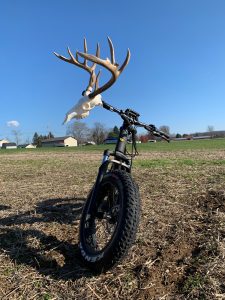
How big of a battery should I get on my eBike? (Watts)
One of the biggest things to consider when selecting an eBike is how many watts do I need? The more watts, the longer the range you’ll have on a charge and the faster the bike, typically. However, the wattage of the battery is key when determining if the eBike that you are operating is legal in some places. Below is a list of states and their maximum wattage to be considered an eBike. This information was gathered on June 1, 2021, so be sure to double-check this information and do not consider this to be the law!
State e-Bike Power Restrictions.
Maximum Power (wattage) – 500 watts
- Maryland
Maximum Power (wattage) – 750 watts
- Arkansas
- California
- Colorado
- Delaware
- Iowa
- Maine
- Michigan
- Missouri
- Nevada
- New Hampshire
- North Carolina
- Pennsylvania
- Texas
- Utah
- Washington
- Wisconsin
Maximum Power (wattage) – 1000 watts
- Georgia
- Kansas
- Minnesota
- Oklahoma
- Oregon
- Virginia
No Maximum Power (wattage)
- Florida
- Mississippi

State-by-State Definition of an e-Bike
- Alaska: Alaska considers electric bicycles as a “motor-driven cycle” and requires a license and registration.
- Alabama: Alabama uses the three-tiered classification of eBikes. Electric bicycles are regulated like traditional bicycles.
- Arkansas: Arkansas uses the three-tiered classification of eBikes. Electric bicycles are regulated in the same manner as traditional bikes.
- Arizona: Arizona adheres to the three-tiered classification of eBikes. Electric bicycles are regulated like traditional bicycles.
- California: California adheres to the three-tiered classification of eBikes. E-Bikes are regulated in the same way as traditional bicycles.
- Colorado: Colorado uses the three-tiered classification of eBikes. Electric bicycles are regulated in the same way as traditional bicycles.
- Connecticut: Connecticut uses the three-tiered classification of eBikes. Electric bicycles are regulated in the same manner as traditional bikes.
- Delaware: Delaware defines eBikes as a “bicycle” as long as the motor is under 750w and the bike has a maximum speed of 20 mph.
- Florida: Florida considers electric bikes to fall under the definition of a “bicycle” capable of being operated by human power.
- Georgia: Georgia uses the three-tiered classification of eBikes. Electric bikes are regulated in the same way as traditional bikes.
- Hawaii: Hawaii classifies electric bikes as “low-speed electric bicycles” when used with a max speed of 20 mph.
- Iowa: Iowa defines an electric bike as a “bicycle” as long as its motor is under 750w and the bike has a maximum speed of 20 mph.
- Idaho: Idaho uses the three-tiered classification of eBikes. E-Bikes are regulated in the same way as traditional bikes.
- Illinois: Illinois adheres to the three-tiered classification of eBikes.Electric bikes are regulated in the same way as traditional bikes.
- Indiana: Indiana uses the three-tiered classification of eBikes. E-Bikes are regulated in the same way as traditional bikes.
- Kansas: The state of Kansas defines an eBike as an “electric-assisted bicycle” as long as its motor is under 1000w and has a maximum speed of 20 mph.
- Kentucky: In Kentucky, an electric bicycle is considered a “bicycle” as long it has operable pedals.
- Louisiana: An electric bicycle is considered a “motorized bicycle” in Louisiana as long as it reaches a maximum speed of 25 mph.
- Massachusetts: The state of Massachusetts defines an eBike as a “motorized bicycle” as long as the bike does not exceed a maximum speed of 25 mph. Riders must carry a license and may be subject to registration requirements.
- Maryland: Maryland uses the three-tiered classification of eBikes. Electric bikes are regulated in the same way as traditional bikes.
- Maine: Maine adheres to the three-tiered classification of eBikes. E-Bikes are regulated in the same way as traditional bikes.
- Michigan: Michigan regulates e-Bikes like traditional bicycles, and the three-tiered classification is used for electric bikes.
- Minnesota: Minnesota defines eBikes as an “electric-assisted bicycle.” Bikes in this category must be equipped with a motor under 1000w and a maximum speed of 20 mph.
- Missouri: Missouri defines an electric bicycle as a “motorized bicycle” as long as it reaches a maximum speed of 30 mph.
- Mississippi: Mississippi defines an electric bicycle as a “bicycle with a motor attached.”
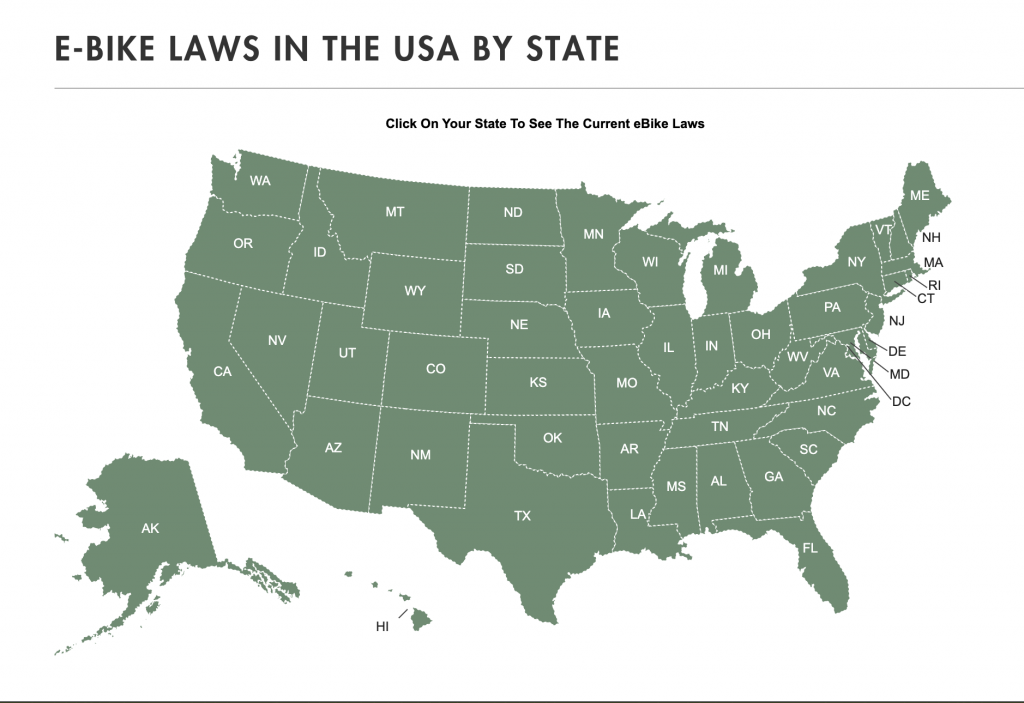
The image above will take you to an interactive map that details each state’s eBike laws. (Reference: eBike Generation)
State-by-State Definition of an e-Bike (continued)
- Montana: Montana defines an electric bicycle as an “electric-assisted bicycle.” A bike can be placed in this category if it has a maximum speed of 20 mph.
- North Carolina: North Carolina defines an e-bike as an “electric-assisted bicycle” if its motor is under 1000w and it has a maximum speed of 20 mph.
- North Dakota: The state of North Dakota defines an e-bike as a “motorized bicycle.” eBikes are subject to the same rules, licensing, registration, and insurance requirements as motor vehicles.
- Nebraska: Nebraska defines eBikes as an “electric-assisted bicycle.” Bikes in this category must have a motor under 750w, and a maximum speed of 20 mph, with pedals operated by human power.
- New Hampshire: New Hampshire follows the three-tiered classification of electric bikes. E-Bikes are regulated like traditional bicycles.
- New Jersey: The NJ definition includes only the first two tiers of classifications used by other states. The legislature also defines “motorized bicycles” as a device that operates over 20 mph with a maximum motor-assisted speed of 28 miles per hour. This definition closely aligns with the Class 3 definition used in other states.
- New Mexico: New Mexico defines an eBike as a “moped.” They are subject to the same road rules, licensing, and insurance requirements applicable to motor vehicles.
- Nevada: The state of Nevada defines an e-bike as an “electric bicycle.” Bikes fall in this category when the motor is under 750w, with a maximum speed of 20 mph, and pedals operated by human power.
- New York: New York state defines electric bikes as bicycles if they have an electric motor of less than 750w and have fully functional pedals.
- Ohio: In Ohio, the three-tiered classification is used for electric bicycles, with E-Bikes regulated like traditional bicycles.
- Oklahoma: Oklahoma follows the three-tiered classification of eBikes. Electric bicycles are regulated in the same way as traditional bicycles.
- Oregon: Oregon defines an e-bike as an “electric-assisted bicycle” if the motor is under 1000w and the bike has a max speed of 20miles per hour.
- Pennsylvania: Pennsylvania defines an electric bicycle as a “pedalcycle with electric assist.” An eBikes falls in this category if the motor is under 750w. It must have operable pedals but a maximum speed of 20 mph when powered solely by the engine. Additionally, the bike must weigh no more than 100 pounds and follow the road’s same rules as a traditional bicycle.
- Rhode Island: Rhode Island defines e-bikes as “electric motorized bicycles.” E-bikes must have fully operable pedals, a max power output of 1491w, and a top speed of 25 mph.
- South Carolina: South Carolina currently has no specific classification for electric bikes. However, since e-bikes are vehicles, they should follow standard vehicle road rules.
- South Dakota: In South Dakota, the three-tiered classification is used for electric bicycles, with E-Bikes regulated like traditional bicycles.
- Tennessee: Tennessee uses the three-tiered classifications for electric bicycles. E-Bikes are regulated like traditional bicycles.
- Texas: The state of Texas uses the three-tiered classification for electric bicycles, with E-Bikes regulated like traditional bicycles.
- Utah: In Utah, E-Bikes are regulated like traditional bicycles, and the three-tiered classification for electric bikes applies.
- Virginia: E-bikes in Virginia are classified as “electric power-assisted bicycles” if they have a motor under 1000w and operable pedals. The max speed for all bicycles and eBikes is 25 mph.
- Vermont: Vermont categorizes e-bikes as “motor-assisted bicycles.” E-Bikes are subject to the same laws as traditional bicycles if they have fully operable pedals. The motor should have a max power output of 1000w and a maximum speed of 20 mph.
- Washington: Washington state regulates eBikes like traditional bicycles, and the three-tiered classification is used for electric bikes.
- Wisconsin: Wisconsin defines an e-bike as a “motor-bicycle” if the motor is under 750w and has a maximum speed of 20 mph. Wisconsin requires electric bikes to be registered, and riders must have a valid license.
- West Virginia: West Virginia defines an electric bicycle as a “moped.” E-Bikes must adhere to the exact licensing and insurance requirements that apply to motor vehicles.
- Wyoming: In Wyoming, eBikes are regulated like traditional bicycles, and the state uses the three-tiered classification for electric bikes.
Do I need to register my eBike with my state?
Most states that define eBikes as vehicles or mopeds require riders to meet the state’s specific registration requirements. States currently requiring eBike registration are

- Alabama
- Alaska
- Hawaii
- Louisiana
- Massachusetts
- New Mexico
- North Dakota
- Wisconsin
- Tennessee
Do I need a license for an eBike?
Most states that define eBikes as vehicles or mopeds require riders to meet the state’s specific registration requirements. States currently requiring a license to operate an eBike are:
- Alabama
- Alaska
- Massachusetts
- Missouri
- New Mexico
- Wisconsin
- North Dakota
Do I need insurance for an eBike?
States which consider eBikes as distinct from motor vehicles do not require the insurance requirements that standard motor vehicles are subject to. However, there are currently three states, including my home state of West Virginia, that require insurance to operate an eBike.
- New Mexico
- North Dakota
- West Virginia
Conclusion
It might seem complicated and confusing at first, but it’s not as a big deal as it might seem. As long as you read the rules and laws for electric bikes for the property you wish to hunt, you won’t have a problem hunting with your favorite eBike. State electric bike rules and regulations change regularly, especially with the increase in popularity in recent years. We recommend you check your local laws periodically so you can legally enjoy the benefits of riding your electric bicycle. Also, if you don’t like the eBike regulations in your state, stand up and fight for a change. Contact the governing body in your area and don’t be afraid to discuss your concerns with your local elected officials. Electric bikes are great for hunting and are much less intrusive than other forms of transportation.
Interested in hunting public land, then check out these 10 public land hunting tips to help you on your next public land hunt.
Hunting Gear Deals is funded by affiliate commissions. We may receive a small commission when you buy from our partners using the links provided. There is no additional cost to you. Thanks for supporting us by using our links when making your purchases.