Have you ever been frustrated while enjoying the outdoors or sporting events when you haven’t dressed for the occasion? My High School son plays football and lacrosse and many times you can’t prepare for what the weather may bring. When the sun goes down, dropping temperatures requires layering, which may combat the cold but minimizes flexibility or comfort.
Being able to stay outdoors while being warm and comfortable is the motto for Fieldsheer products featuring their Mobile Warming technology. This technology utilizes heating elements, placed strategically throughout the jacket, to battle the cold (those frigid temperatures). Recently I was able to put that to the test when I received the Performance Series Tundra Jacket.
Upon my initial inspection, I was impressed and noticed features that stood out from most parka manufacturers. In this article, I would like to cover those as well as the main features, which will determine if this jacket lives up to its name. Many of the specialized features of the jacket include Trademark names such as Waterpell, Wind-Shark, Zapsheer and Nightsheer.

Fieldsheer Tundra Jacket
The Fieldsheer Tundra Jacket is designed to keep you warm, dry, and comfortable through whatever mother nature can throw at you. The heated panels in this jacket will keep you toasty without having to wear tons of bulky layers.
Price: $187.49
- 4 heated panels across chest, back, and arms
- Rechargeable lithium-ion battery
- Wind and water resistance
- Control heat from garment or phone app
- 8 hours of power per charge
Fieldsheer Tundra Jacket Review | Mobile Warming Technology
With the Fieldsheer Tundra Jacket incorporating heating as well as Bluetooth technologies, I thoroughly read the manual to familiarize myself with the operation. The heating elements within the jacket are powered by a 7.4 volt 4000 mAh Lithium-Ion battery. The battery is conveniently store in an inner sleeve of the right pocket. There are four heating element locations sewn into the lining of the jacket: one in the collar, one each within the chest area, and the final in the lower back. The collar element is 8.5” by 2”. The chest and lower back elements all measure 6.5” by 3”.
The heating elements can be controlled by either a button switch or Bluetooth app. The button switch is located in the inner lining, near the zipper in the lower right front of the jacket. Simple push-button operation controls the warmth setting of the jacket. The Bluetooth feature (called MW Connect) is controlled through an app, which can be downloaded from Google Play or the Apple app store. I conveniently downloaded the Android version onto my Samsung phone.
Upon initial activation, the app auto scans via Bluetooth for available Mobile Warming garments that have been activated. When found, the garment can be named for reference. The app can control several additional Mobile Warming items, including pants, socks, and vests. Icons positioned on the right side of the app screen allow you to quickly switch between and control each garment.
When selected, the app will display the battery and temperature setting with circular icons near the top. In the middle of the icons, the battery level and temperature are displayed. As the battery drains or the temperature changes, the outer circle lighting will change representing the level.
Moving down to the middle of the screen, a human figure and garment icons are displayed. Simply choose the garment icon and the figure will display an animated, lighted area representative of the garment.
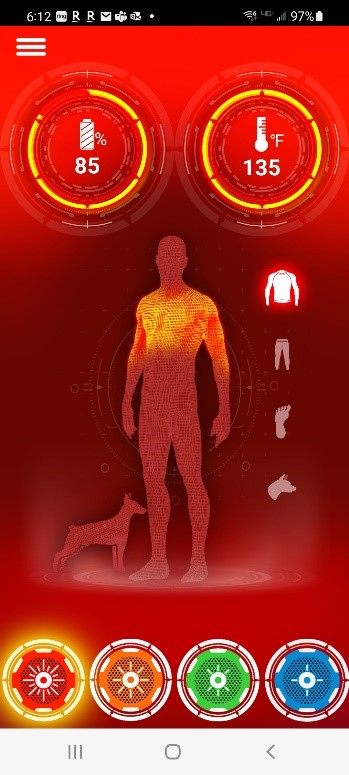
At the bottom of the screen are four colored circles that represent the temperature setting of the jacket. Beginning on the left, a red-colored wheel indicates the jacket is operating at the highest temperature setting of 135°F. The yellow-colored wheel represents 120°F, green is 105°F, and finally blue is 90°F. The temperature is changed via the app by touching/selecting the colored wheel or manually by pressing the button on the jacket. The app and button work in unison; if the button on the garment is pressed, the app will register the temperature change.
Fieldsheer Tundra Jacket Review | Construction/Materials
Fieldsheer has over 40 years of experience in developing and testing outdoor gear. The technology in the following paragraphs were field-tested in a variety of Ohio late winter and early spring environments. That means temperature changes from freezing to mid-50s with precipitation ranging from snow to downpours.
The outer shell uses Windshark technology, which prevents the wind from penetrating and robbing you of retained warmth from the Mobile Warming Technology, as well as body heat. The WindShark technology utilizes a breathable membrane as well as a water repellant coating referred to as Waterpell.
Waterpell combines a natural fiber and synthetic material with antimicrobial properties to give you the highest level of comfort. The secret to this technology is the pore size of the garment material combination, allowing perspiration to evaporate while keeping you dry from any form of precipitation.
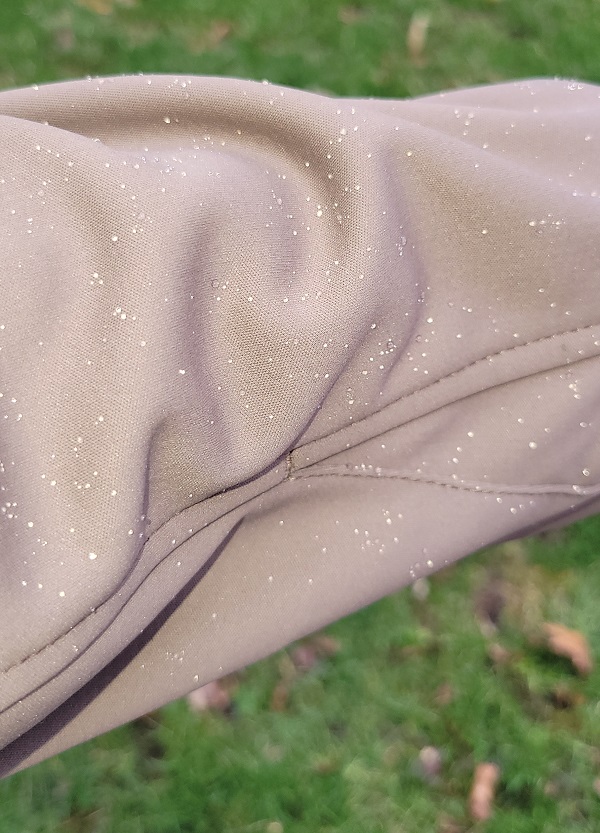
Zapsheer is a technology also incorporated into the Tundra Jacket by weaving conductive fibers into the fabric. These fibers rob or dissipate static electricity, which is a characteristic of synthetic fiber, especially tight knit fabric used in waterproof or water-resistant garments.
The jacket has a nice sized hood with a drawstring, allowing the opening to mold to your face without limiting visibility. How many times have you put up your hood only to have it blocking your view? The additional drawstring in the top of the hood helps the fit even more.
The bottom of the Tundra Jacket can also be adjusted for fit and to stop wind when sitting, provided the jacket is zipped up. Two drawstring adjustments on the sides of the jacket allow for a comfortable fit.
I also find the drawstring a great complement when using the Mobile Warming Technology. Heat can build up fast in the hood alone, but by simply adjusting the tension on the drawstring, you can allow excess heat to dissipate while remaining comfortable. The drawstrings feature an easy stop crimp spring design for adjustability. These make it easy to cinch the drawstring or easily release with the push-spring, activated button.

The Tundra Jacket incorporates unique features other manufacturers overlook, such as zippered vent opening in the armpits and cuff expansion insets. The zippered vents are engineered to be easily opened with a pull string zipper. It is a must to control airflow and help air circulation and it’s especially helpful during outdoor activities such as hiking.
The cuff expansion insets are comfortable when tucking gloves or mittens into the lower sleeves. Some jacket manufacturers have tight or elastic closures, which makes it very uncomfortable (especially when using gloves) as everything bunches up on your wrists.
Fieldsheer Tundra Jacket Review | Battery/Battery Life
The battery is charged via a USB-micro port and the charge time is approximately 4 hours from drained to fully charged at 5 VDC, 2.1 Amps. Battery output is through a DC power outlet, located on the side of the battery supplying the required 7.4 volts for the jacket. There is also a secondary USB-A port supplying 5V 2 Amps that could be used to charge a cell phone or comparable device.
Battery life was tested on the two highest temperature settings during outdoor events. The first event was my son’s lacrosse game, with a game time temperature of 36°F and a wind chill of 26°F. With a long sleeve base shirt and sweatshirt, the Tundra Jacket was comfortable with ample room allowing flexibility. I was very happy to be wearing the Tundra Jacket with the hood in the gusty winds. The neck element was probably the most important element on the jacket during this outing. It combined with the Windshark technology to keep my neck and upper shoulders very comfortable. Don’t get me wrong – the chest and back elements did their job as well, but the neck and shoulders felt the best.
On the highest heat setting of 135°F, the jacket lasted under 3.5 hours, which is a little more than the 3.2 hours listed in the manual. The next highest setting of 120°F lasted for 4 hours and 20 minutes, which is right on the 4.3 hour recommendation. Utilizing the phone app to monitor the jacket, I could take a quick glance to see the battery. It is much easier to change the temperature setting through the app than opening the jacket to access the button.
The jacket can be laundered on the delicate cycle and tumbled dry on low heat. This is exceptional given it has four heating elements controlled with Bluetooth technology.
PROS:
CONS:
Fieldsheer Tundra Jacket Review Summary
I find the Fieldsheer Tundra Jacket to meet its intended purpose for a heated garment. The fit and feel of the jacket are exceptional. Even without the Mobile Warming Technology, I find the jacket comfortable in temperatures beginning in the 40’s and above. The warming technology can push that an additional 10 to 15 degrees.
The only improvements I would recommend on the Tundra is a little heavier duty zipper. I understand the smaller zipper helps to keep out wind, but it was difficult at times to start as I had to make sure that the end was tightly secured to begin the zip process.
In closing, a one-year warranty covers the construction of the jacket as well as electrical components including the battery.
Ready to buy? The Fieldsheer Tundra Jacket can be purchased from a variety of online retailers including The Warming Store, Sportsman’s Warehouse, Walmart, and Amazon.
Thanks to Fieldsheer for supplying this product for me to review and thanks to David for the review and high-quality photos. Hunting Gear Deals is funded by affiliate commissions. We may receive a small commission when you buy from our partners using the links provided. There is no additional cost to you. Thanks for supporting us by using our links when making your purchases.